
Emergency Water Damage Restoration Near Me: What West New York Homeowners Should Do First
Emergency water damage restoration in West New York means acting in the first 90 minutes to stop water migration, document the loss, and get real equipment running on-site. If you’d rather not handle any of it yourself, call (640) 221-3499 and a live dispatcher at Floodline Restoration Co. will answer, 24/7. The costs of waiting are measurable: in a garden apartment with a burst supply line, we routinely see the difference between a $4,000 dry-out and a $40,000 rebuild decided inside the first hour and a half.
Key Takeaways:
- Shut off the water source and kill power to affected rooms in the first 10 minutes – those two actions alone regularly save tens of thousands in West New York rowhouses.
- Photograph everything before you move anything. Timestamped photos are what turn a disputed claim into a settled one.
- Verify the restoration company has equipment on the truck and a live dispatcher, not an answering service – at 2 a.m. the difference matters.
- Most Category 2 and 3 water does not get “cleaned up” by a shop vac. It gets cut out, bagged, and disposed of. Know the line before you cross it.
What Actually Matters in the First 90 Minutes (And What Most Guides Skip)
Porous concrete block – the foundation material in the majority of West New York’s older rowhouses and garden apartments – absorbs water at roughly four times the rate of poured concrete. Every hour before extraction begins is not equal: in that material, the damage curve is steep in the first two hours and flattens considerably after hour six. That means the first 90 minutes are not about being thorough. They are about being fast.
Here is the sequence we give homeowners over the phone while the crew is en route. It is specific to the housing stock here, because a pre-war rowhouse on 60th Street behaves differently than a new construction off Boulevard East.
- Shut the water source. If it’s a supply line, fixture, or appliance leak, close the nearest shutoff valve, then the main valve at the street or the basement. In West New York, the main is often behind an access panel in the front stoop wall. Do not wait for a landlord or super if you rent – call them after the water is stopped.
- Kill power to the affected level. If water has reached outlets, power strips, or appliances, shut the breaker. Do not stand in water to reach a panel. If the panel is dry but the floor is wet, use a wooden broom handle to flip breakers or call us and we’ll do it when we arrive. Electrical shock in a wet basement is real, and it’s not the kind of emergency you can undo.
- Photograph everything, from three angles. Before you move a single item, take wide shots of each room, then close-ups of the water source, the water line on the walls, and any damaged contents. Use your phone’s timestamp. This is the documentation that supports an insurance claim, and it takes two minutes.
- Move what is reasonable – and nothing more. Lift small furniture onto blocks or foil. Pull throw rugs and loose textiles up off wet floors. Move books and papers to dry ground. Do not move wet carpet that has been sitting in water for more than an hour. You will tear the backing and double the repair cost.
- Call restoration, not a handyman. A handyman with a wet-dry vac is not emergency extraction. He is a delay with a receipt. Emergency water damage restoration requires extraction, dehumidification, and moisture mapping – equipment that has to be on the truck before anyone says “en route.”
What you do before the crew arrives in West New York matters. We have walked into basement apartments where the homeowner moved carpet and saved a subfloor, and we have walked into rowhouses where a neighbor “helped” by dragging a soaked sofa across a wood floor and turned a $6,000 job into a $22,000 one. Speed matters. So does restraint.
How to Verify a West New York Restoration Company Is Actually Coming – Not Just “On Call”
Call five emergency restoration numbers at two in the morning anywhere in Hudson County and you will get four answering services. That is not a criticism of answering services. It is a fact about an industry where a lot of “emergency” companies are actually marketing operations that sell your lead to whichever crew is available – sometimes in another county, sometimes another state.
Here are the questions that separate a live dispatcher from a call-center script, and a real crew from a lead seller:
- “Are you in West New York right now?” A live dispatcher at a local office can answer this. A lead-generation service will say “we have crews in your area” – which can mean Paterson or Newark or a subcontractor who doesn’t know the difference between a stoop and a setback.
- “What equipment is on the truck that’s heading here?” If they can’t tell you, they don’t know. Emergency extraction needs at minimum a truck-mounted or high-output portable extractor, air movers, and dehumidifiers – not a crew with a clipboard and a shop vac doing “assessments” at $85 an hour.
- “Will the same crew handle the drying and the rebuild?” In our experience, the biggest cost driver in West New York restoration work is the handoff. Company A extracts. Company B dries. Company C rebuilds. Every handoff is a chance for “that’s not my job.” Full-cycle companies – like ours – are set up to avoid that break.
- “Do you bill my insurance carrier directly?” If the answer is anything but “yes, with photo documentation and a moisture log,” you should keep dialing. Direct carrier billing is standard for credible restoration firms. It is not a favor; it is how the industry works.
West New York’s housing stock makes this verification more important than in suburbs with single-family homes. A garden apartment on Palisade Avenue might have a common wall with neighbors you don’t know and a co-op board that wants documentation. A rowhouse on 54th Street might have a shared drain line with the building next door. The company you call at 2 a.m. is the company whose name goes on the certificate the co-op board and the carrier will hold onto. Make it a name you can hold accountable.
What “Emergency Extraction” Actually Requires: Equipment to Confirm On-Site
The first thing a real emergency extraction crew does is not extract. It is map. A technician trained to IICRC standards will use a moisture meter to map the affected area, find the water migration path through porous concrete block, and read the wall cavities where the real damage hides. Then extraction starts.
Here is what should show up on the truck, and what each piece does:
- A truck-mounted or high-output portable extractor. This pulls standing water out of carpet, pad, and hard surfaces. A shop vac is not this. We run commercial extractors that move thousands of gallons an hour and take carpet down to damp, not dripping.
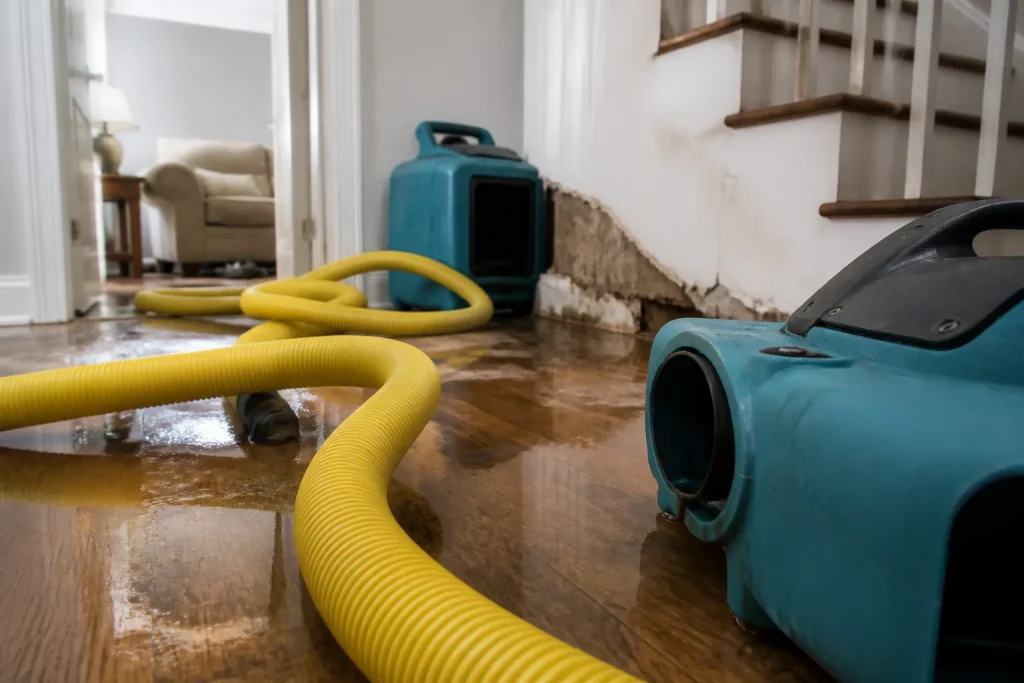
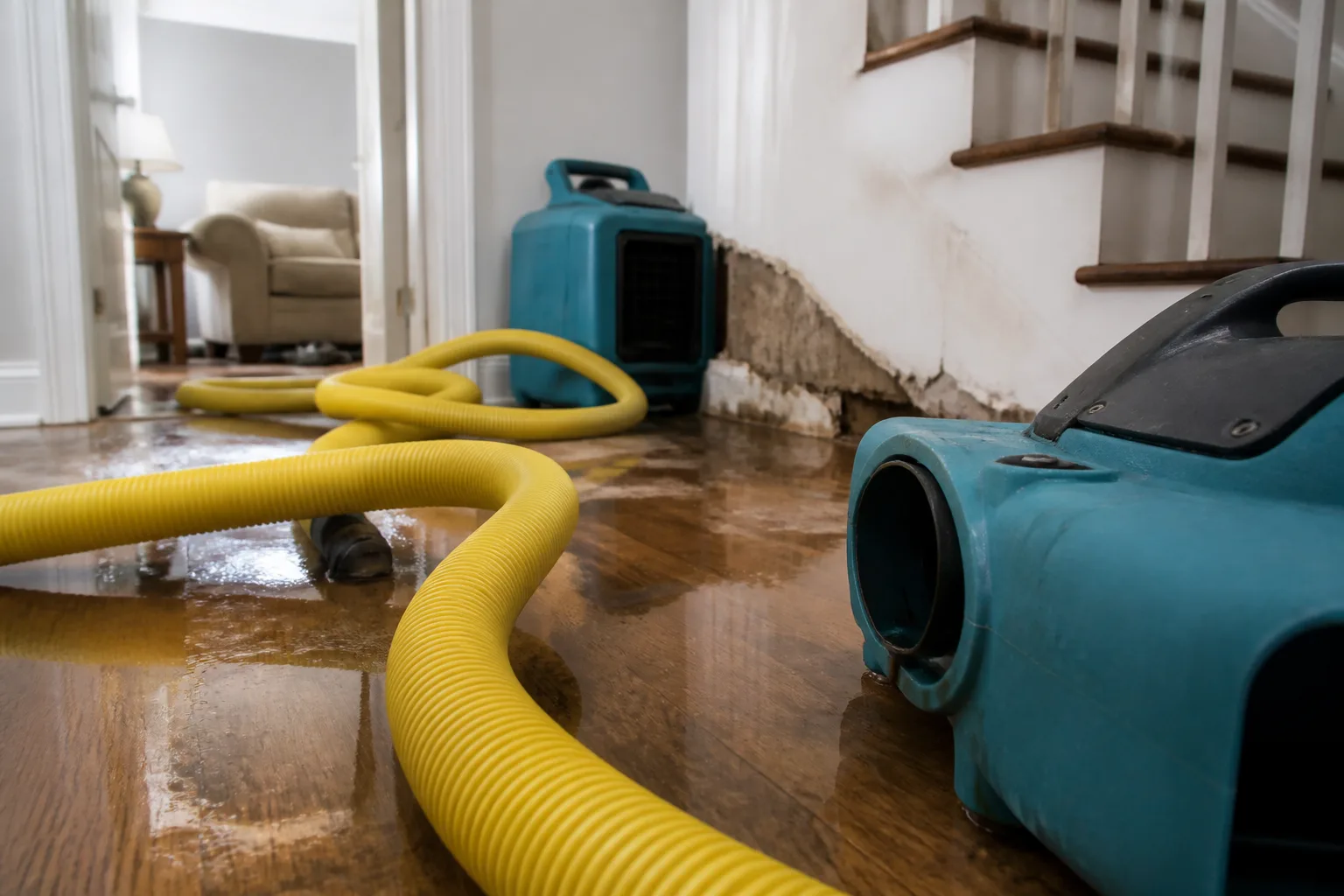
- Air movers. A minimum of three to five per affected room, positioned to create a drying vortex. We use Dri-Eaz, Phoenix, and XPOWER units – the kind of gear that moves a thousand cubic feet per minute, not the fan from a big-box store.
- Dehumidifiers. LGR (low-grain refrigerant) dehumidifiers, not the $200 basement unit. The LGR units pull moisture out of the air quickly enough to keep it from re-saturating the block walls, which is the entire game in a West New York garden apartment basement.
- A thermal imaging camera. This is not decorative. A thermal camera reads the water you cannot see inside walls and under flooring. If the crew’s first step is ripping up carpet without a thermal read, you’re getting a bigger job than you need.
- Injectidry or equivalent injection drying. This is for water trapped in wall cavities and under floor systems. Injection drying gets air into the spaces that dehumidifiers alone can’t reach, and in older West New York construction, those cavities are everywhere.
You don’t need to know all this to have a good reason for asking the question. “What equipment is on the truck?” is a test of whether you’re getting a restoration company or a sales lead. Real companies answer instantly.
A square deal means no surprises on the bill, but it also means no surprises about what “done” means. When our crew finishes extraction, the moisture log is started, and you get a daily reading until the dry standard is met – not “well, it feels dry.” The line the water left is where we start, and the reading is how we prove it.
Documentation to Start Collecting Now (For the Insurance Claim You’ll File Today or Later)
Insurance is almost always in the room when there’s water damage, even if nobody names it. The carrier is not your enemy, but the carrier is not your advocate either. What makes the difference between a settled claim and a negotiated pain is documentation collected in the first hours.
Start this list while you’re waiting for the crew. It takes twenty minutes and directly supports whatever claim you file.
- Photos with timestamps. Wide shots of every affected room, close shots of the source, before-and-after of any item you move. Your phone stamps these automatically. Do not stage them. Do not clean up before the shot. The claim adjuster needs to see what the water actually did.
- Water source identification. Write down what failed: supply line, drain backup, sewage ejector pump, roof penetration, window flashing. The source determines the water category, and the category determines what the insurance policy says about coverage and process.
- Material inventory. List what got wet and what it’s made of: carpet and pad, hardwood, drywall, baseboard, particle board cabinets, personal contents. Materials matter because some dry, some get cut out, and the carrier pays differently for each.
- A time log. Write down when you discovered the water, when you called the restoration company, when the crew arrived, and when extraction started. If the claim ever has a dispute about “reasonable mitigation,” that log is your record of a reasonable response.
Floodline Restoration Co. carries this burden with you, not for you. We document every step of the process, and we bill the carrier directly – so you never play messenger between our work and your insurer. That is a standing part of how we work in West New York, not an add-on for good customers.
The Risk of Accepting the First Company to Answer the Phone
We tell homeowners in West New York something most restoration companies won’t say out loud: The first number that pops up for “emergency water damage restoration near me” is often a lead-generation service, not a restoration company. That service takes your information, sells the lead to a contractor, and the contractor who shows up may have no local reputation, no local references, and no reason to care about a job done right in a town they’ll never work in again.
The risks are specific. A subcontractor paid by the job has every incentive to extract fast and skip the drying detail. A crew with no local shop has no accountability to a physical business address. A company that talks only about “mitigation” and not about the rebuild is setting up a handoff – and when the handoff happens, the bill goes up, the timeline stretches, and the homeowner is the one out of pocket for the gap.
That last risk is the one that costs West New York homeowners the most in our experience. Water damage restoration is not just extraction. It is drying, monitoring, documenting, and then rebuilding what needs rebuilding. When one company extracts and another rebuilds, the homeowner becomes the project manager. The homeowner has to explain the moisture log to the builder, argue about the dry standard, and negotiate who pays for the drywall that we all knew had to be replaced on day three. That is not a square deal. That is a mess with a phone number.
Floodline Restoration Co. keeps the job whole from first extraction to finished rebuild, and we put the 90-Day Done Right Promise – what we call the Keystone Standard – in writing. If it’s not done right, we make it right. No arguing. No paperwork battles. That promise is why we structure the work the way we do, and it’s why we tell West New York homeowners to ask any restoration company one more question before they hang up: “Who handles the rebuild if it needs one?” If the answer is a different company, you’ve got your warning.
We pulled a dry-out out of a garage over on 71st Street last month where the homeowner had already accepted a “restoration” company’s $3,900 “assessment.” The crew showed up with a clipboard and a camera, took photos, and left. No extraction. No drying. The phone number on the estimate routed to a call center in another state. The homeowner called us four hours later, after the water had gone from the garage floor into the neighbor’s storage closet. That’s a real story, and it’s the reason we ask people in West New York to call our number – (640) 221-3499 – and hear a live person answer, any hour.
When to Call a Pro
Some water damage can wait until morning. Check the source. If the water came from a clean supply line, you discovered it within the hour, and the affected area is small enough to dry with fans and open windows, you might reasonably tackle it yourself. Move fast, document, and monitor.
If any of these are true, call immediately: the water is from sewage or a drain backup (Category 2 or 3), water has touched electrical outlets or the breaker panel, the surface area of water is larger than a single room, or the home is a rowhouse or garden apartment with shared walls. In those buildings, water migrates through porous concrete block into adjacent units, and the liability for “your” water ends up in your neighbor’s drywall. We have seen a slow supply-line leak in one rowhouse unit become a three-unit mitigation because the water found the common wall and the shared joist bays overnight.
Related services in West New York: Water Damage Restoration in West New York, Mold Remediation in West New York, Fire & Smoke Damage Restoration in West New York. If the water has sat for more than 48 hours, mold is no longer a risk; it’s a schedule.
The Bottom Line
Emergency water damage restoration in West New York comes down to four things: stop the water, kill the power, document the loss, and get real extraction equipment on-site before the water spreads through the block. Porous concrete block – the material under most of the rowhouses and garden apartments here – absorbs fast in the first two hours. The first company to answer the phone is not always the best; ask about live dispatch, equipment, and who does the rebuild before you let anyone in the door.
If you’re in West New York and need help, Floodline Restoration Co. offers free estimates – call (640) 221-3499. A live person answers, 24/7, and a certified crew reaches the job with extraction running the same visit. That is not a marketing line. That is the dispatch board we’ve been running since 2010.
We stand behind it. In writing.
Frequently Asked Questions
Floodline Restoration Co. operates 24/7 with live phone dispatch, not an answering service, so a local crew is typically dispatched within minutes of your call and reaches most West New York addresses within the hour. A company that says “we’ll have someone call you back” is not emergency restoration; that is a callback queue. Call (640) 221-3499 if water is moving through your home right now.
Most homeowner policies in New Jersey cover sudden and accidental water damage, like a burst supply line or an appliance failure, but they typically exclude damage from long-term leaks, neglect, or sewer backups unless you have a specific endorsement. What insurance always rewards is documentation: photos with timestamps, a source identification, and a material inventory. Floodline bills your carrier directly and provides the photo and moisture documentation claims require, so you never play messenger between our work and your insurer.
If the water is clean, caught early, and limited to a small area of hard flooring, you may be able to dry it without professional help. But if the water is from any drain or sewage source, has touched electrical components, has spread larger than one room, or is in a rowhouse or garden apartment with shared walls, you need professional extraction, drying, and moisture mapping. The water that matters is invisible – inside wall cavities, under flooring, in the porous concrete block that most West New York homes sit on. We find it with thermal imaging and dry it with commercial-grade LGR dehumidifiers. If you’re not sure, call (640) 221-3499. The estimate is free, and we’ll tell you honestly what you need and what you don’t.
Document the water line and source with timestamped photos, then call your own restoration company, not just your neighbor’s. The neighbor’s carrier may deny the claim, and waiting for their adjuster means your damage compounds while the units penetrate the floor system. In West New York rowhouses and garden apartments, shared walls and joist bays mean “their” water becomes “your” mold in 48 hours. Floodline Restoration Co. will extract, dry, and bill the appropriate carrier directly, with a moisture log that protects you if the claim gets disputed. Call (640) 221-3499 and a live person will walk you through what to do right now.
Written by Curt Bowman, Owner at Floodline Restoration Co., serving West New York since 2010.
Need Damage Restoration Help?
Call Floodline Restoration Co. - licensed & insured, here with fast after-hours help in West New York.
(640) 221-3499