
Water Damage Restoration Cost Guide: What West New York Homeowners Pay in 2026
Water damage restoration in West New York typically runs $3.50 to $8.50 per square foot for extraction and drying in 2026, translating to roughly $3,200 to $7,650 for a 900-square-foot apartment. But that number barely matters here. In West New York, where a condo stacks above a finished basement and shares walls with two other units, the real cost driver is access complexity, not floor area. If you’re staring at a wet floor right now and want a straight answer, call (640) 221-3499.
The national average gets quoted everywhere, but it’s calculated from suburban single-family homes with crawl spaces, detached walls, and room to park a truck. West New York is one of the most densely populated municipalities in the United States. That geography changes every cost variable, from how we get equipment into the building to how far moisture travels once it leaves your unit.
We’re Floodline Restoration Co., and we’ve been doing this work in West New York since 2010. This guide is what we tell homeowners who call us at 2 a.m. asking what this is going to cost. No sugar-coating. Just the numbers, the line items, and the questions worth asking.
Key Takeaways
- Category 1 (clean water) jobs in West New York average $1,800 to $4,200; Category 3 (sewage) jobs run $6,500 to $15,000+.
- Building access is the single largest cost multiplier in West New York, not square footage.
- Splitting extraction and rebuild into two contracts routinely adds 20-35% to total cost.
- Direct insurance billing can cut out-of-pocket exposure by thousands versus paying upfront and chasing reimbursement.
- A legitimate invoice comes with moisture logs, equipment placement records, and daily readings. Demand them.
What West New York Homeowners Actually Pay by Damage Category
Every restoration job starts with a category. It’s not a technicality. The category determines what gets torn out, what gets saved, and what the bill looks like at the end.
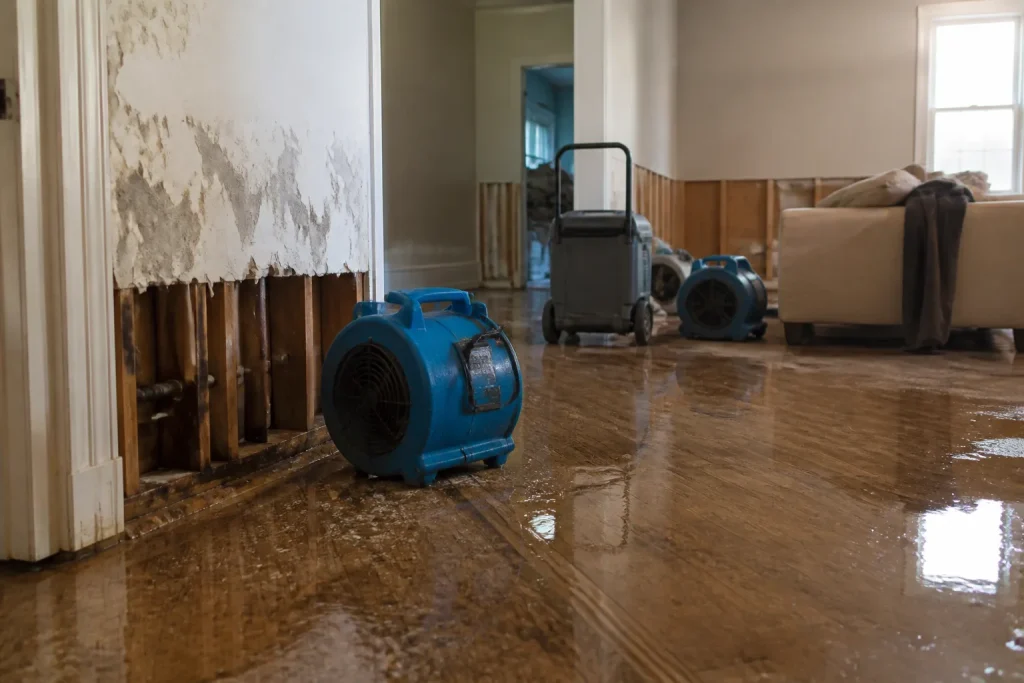
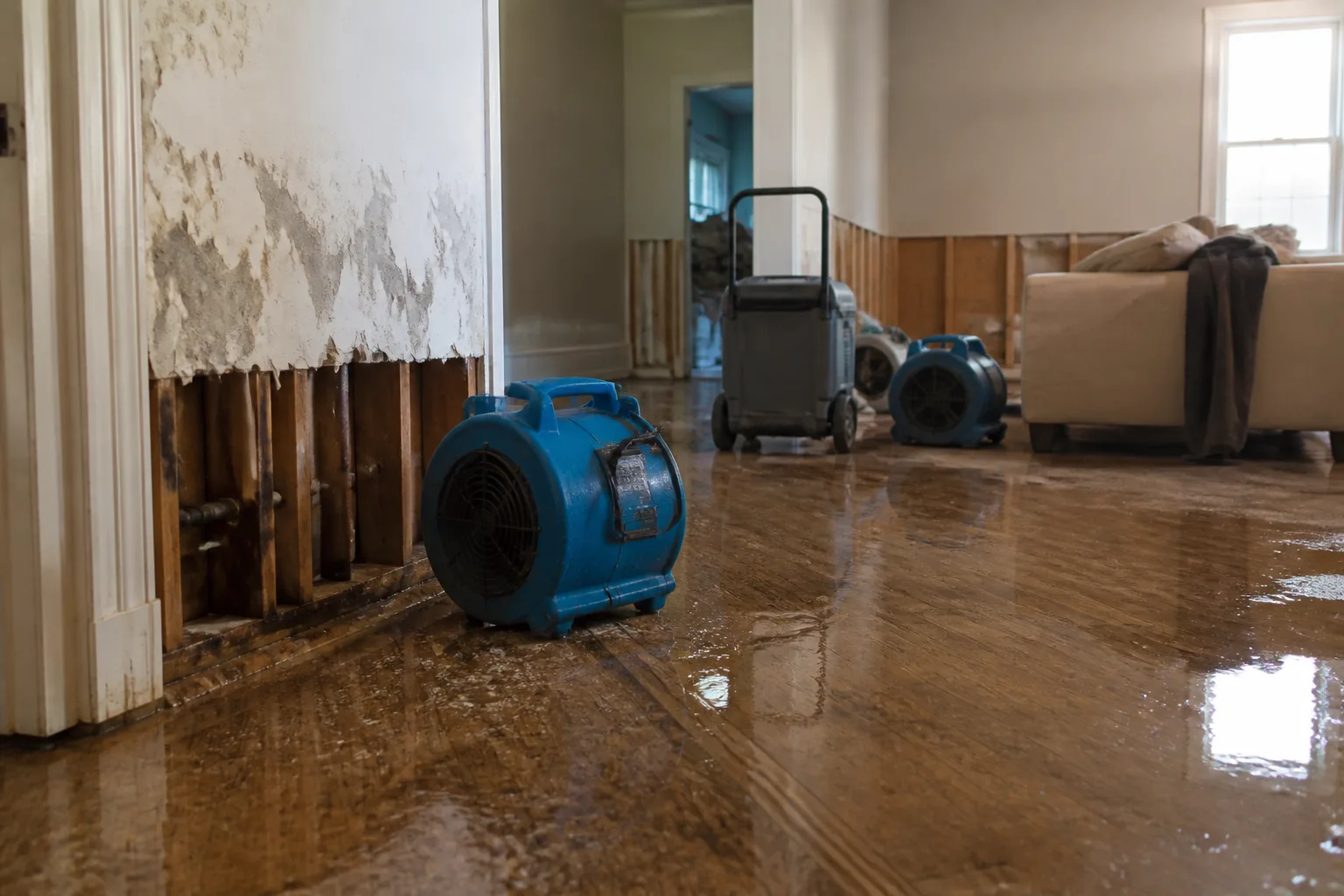
Category 1: Clean water. This is water that came from a supply line, a failed water heater, or an overflowing bathtub. No contaminants. In West New York, expect $1,800 to $4,200 for a typical one-room event in a 600 to 900 square foot apartment. Drying usually takes three to five days with professional equipment. We run Dri-Eaz dehumidifiers and XPOWER air movers, with daily moisture readings logged until the dry standard is met.
Category 2: Gray water. This is water with biological or chemical contaminants, think washing machine discharge, dishwasher overflow, or sump pump failure. The cost range in West New York is $3,500 to $7,000. You’re paying for antimicrobial treatment on top of extraction and drying, and often for removal of baseboards and a section of drywall. The job just got bigger.
Category 3: Sewage and black water. This is the one people don’t want to hear about. Sewage backups are common in older West New York buildings where cast-iron waste lines run through the slab. Category 3 work means full containment, disposal of contaminated materials, and often floor removal. Costs run $6,500 to $15,000 or more depending on how far the contamination traveled. We handle this with full PPE and documentation for the carrier. This is not a job to put off, and it’s not a job to hand to a handyman.
Why Square Footage Is the Wrong Metric in West New York
Square footage matters in a suburban rancher. It barely matters here. A 900-square-foot unit on 60th Street with street access and a ground-floor entrance is a different job than a 900-square-foot unit on the fourth floor of an elevator building on Boulevard East. Same square feet. Different cost.
The national-average numbers floating around assume a crew can back a truck up to the door, run hoses, and be running equipment within 45 minutes of arrival. In West New York, we’re navigating metered parking, often the biggest hidden cost on the job. A restoration van needs space for extraction units, drying equipment, and disposal. A full day of metered parking for two trucks can add $80 to $150 to a job before we’ve touched a wall.
In elevator buildings, we’re scheduling with the management office, protecting corridors, and sometimes paying for elevator time. In walk-ups, every piece of equipment goes up the stairs. On a fourth-floor sewage job that runs five days, that’s five days of stair carries. It shows up on the invoice as a labor line item, and it should.
Then there’s the shared-wall problem. In a row of attached homes or a condo stack, water doesn’t respect property lines. We’ve pulled moisture out of a second-floor unit on Polk Street where the source was a failing shower pan in the unit next door. Moisture migrated through the party wall. That means the drying plan has to account for the adjacent unit’s cavity, not just the wet room. That’s an access problem, a coordination problem, and a cost problem that no square-footage formula captures.
The Hidden Cost Multipliers Specific to West New York
Almost every invoice surprise in this town traces back to one of these four multipliers. Knowing them ahead of time won’t make the problem smaller, but it’ll make the bill less shocking and the conversation with your adjuster more productive.
1. Permit Requirements for Structural Drying in Multi-Unit Buildings
West New York’s building department requires permits for restoration work that involves structural opening in multi-unit buildings. That includes cutting drywall, removing flooring, or exposing framing. Permit costs run $150 to $500 depending on scope, but the real cost is time. A permit that takes two days to pull is two days the structure stays wet. Wet days mean more damage, and more damage means a higher final bill.
We handle permitting as part of the job. Some restoration companies leave it to the homeowner. If a company puts the permit on your plate, ask why.
2. Metered Parking and Equipment Access
Already touched on this, but it deserves its own line. A three-day drying job with two trucks, a trailer for the big Dri-Eaz units, and disposal runs can rack up $250 to $500 in parking costs alone in neighborhoods around Park Avenue and 60th Street. Legitimate companies itemize this. Question any invoice that buries parking inside a vague “logistics” line with no explanation.
3. Shared-Wall Moisture Migration
When water migrates into a party wall or through a ceiling assembly shared between units, the drying plan has to include the adjacent space. That means coordinating with neighbors, building management, and sometimes doing work in a unit the homeowner doesn’t own. The cost of that coordination and extra equipment jumps a job 15 to 25%. It’s not padding. It’s the physical reality of dense housing.
4. Elevator and Walk-Up Access
In buildings without a service entrance wide enough for our equipment, everything goes through the passenger elevator or up the stairs. Elevator time may have to be booked and paid. Walk-up carries are billed as labor hours. A third-floor job with a full drying setup can add $300 to $600 in access-related labor versus ground-floor work. When you hear a quote that seems high, ask what’s in the access line. It should be specific.
Why Splitting Extraction and Rebuild into Two Contracts Costs More
The restoration industry has a habit of splitting work. One company extracts and dries. Another company does the rebuild. On paper it looks fine. In practice, it’s where homeowners get burned.
Here’s what happens. The extraction crew tears out wet drywall, removes the flooring, and runs drying equipment. They leave when the moisture meter hits the dry standard. The rebuild crew shows up weeks later, sees the framing, and finds something the extraction crew missed, or something that dried poorly. Now you have two companies pointing at each other. Neither owns the gap. You’re stuck with the argument and the bill.
The financial math is worse than the finger-pointing. When two companies work a single job, both carry their own mobilization costs, their own overhead, and their own profit margin. You pay mobilization twice. You pay for the rebuild crew’s site-survey time to understand what the extraction crew did. You pay for the homeowner to coordinate between the two. In our experience here in West New York, the split-contract approach adds 20 to 35% to total cost versus one company owning the entire job from first extraction to final paint.
We don’t do split contracts. The crew that reads the moisture map on day one is the same crew that takes daily readings, hands the log to the homeowner and the carrier, and rebuilds what needs rebuilding. It’s slower to schedule that way, but it’s cheaper and cleaner in the end, and nobody argues about whose fault the gap is. See our Water Damage Restoration in West New York page for how we run the full cycle.
Direct Insurance Billing: What It Actually Saves You
Insurance is in the room on almost every water damage job in West New York, even when nobody says the word aloud. How the billing works changes what leaves your checking account.
With the pay-upfront-and-reimburse model, you write a check for the full job, then wait weeks or months for the carrier to send money back. That means you’re floating $5,000 to $15,000 of restoration cost while also dealing with a wet house. And if the carrier disputes any line item, you’re the one arguing with an adjuster who knows the process better than you do.
Direct billing flips that. The restoration company works directly with the carrier. The adjuster gets daily moisture readings, photo documentation of equipment placement, and a written scope before work starts. The carrier pays the vendor. The homeowner isn’t playing messenger. They’re not fronting thousands of dollars they’ll eventually get back. That’s the way we’ve run jobs in West New York since 2010, and it’s the single biggest trust unlock in this trade.
The other piece: photo documentation. Every legitimate restoration company photographs the damage before touching anything, during the drying process, and after the rebuild. Those photos go to the adjuster. They’re what separates a covered claim that gets paid from a disputed claim that stalls for months. If the company you’re talking to says they’ll “document everything” but can’t show you a written scope before work starts, keep looking.
Line Items Worth Questioning on Any West New York Restoration Invoice
Most invoices in this industry are legitimate. But the bad ones count on homeowners not knowing what to ask. Here’s what we tell people to look at.
Moisture logs. Every job should have daily moisture readings logged from the first day until the dry standard is reached. A legitimate invoice references those readings and shows drying progress over time. If an invoice shows three days of drying with no readings and no dry standard, that’s worth a phone call.
Equipment placement records. You should know exactly how many air movers and dehumidifiers ran, where they sat, and for how many days. We use Phoenix and B-Air units, and every placement is logged. If a company charges for equipment days without telling you what ran where, ask for the placement log. Legitimate companies have one.
Access and parking. This is a West New York-specific line item that no national cost guide will tell you about. It should be specific: how many trucks, how many days, at which address. A vague “logistics fee” is worth questioning.
Permit fees. If structural opening happened in a multi-unit building, there should be a permit cost. If the invoice shows a permit line and you never saw a permit, that’s a red flag. If structural work happened and there’s no permit line, that’s a bigger one.
Supervision and project management. Some companies charge overhead as a percentage of total job cost. That’s legitimate. But a line item for “project management” should mean something specific: who was on site, how often, and what they did. If it’s a number with no explanation, ask for the detail.
When to Call a Pro
Some water events are manageable with a mop and a fan. A puddle from a spilled glass? Fine. A toilet overflow that sat for an hour before you noticed? You’re in gray-water territory. Any of these and it’s time to call:
- Water has been standing for more than 12 hours, and it’s not a small puddle.
- The water source might be contaminated, including washing machine discharge, dishwasher overflow, or anything from the sewage system.
- The water touched drywall, baseboards, or flooring materials that hold moisture.
- You smell anything musty, which means microbial growth may already be underway.
- The water is in or near a shared wall or floor assembly. In West New York that’s most walls.
We pulled a job out of a garden-level unit off 54th Street last month where the homeowner had dried the visible water with towels and fans for three days. The floor felt dry. The subfloor wasn’t. By the time we got there with a moisture map, the reading under the tile was 34%. That’s a rebuild job that could have been a three-day drying job if it had been caught on day one. Call early. It’s cheaper.
If you’re in West New York and need help with water, mold, fire, or any of the messy stuff, call us at (640) 221-3499. Related services in West New York: Mold Remediation in West New York and Fire & Smoke Damage Restoration in West New York.
The Bottom Line
Water damage restoration in West New York doesn’t follow national cost guides for one simple reason: the housing stock here is stacked, attached, and accessed differently than a suburban single-family home. A 900-square-foot unit can cost $1,800 to dry or $15,000 to restore, depending on water category, which floor it’s on, what’s in the walls, and whether the build is being pulled into the scope.
The variables that matter most are access complexity, water category, shared-wall moisture, and whether you’re paying one company to own the job or two companies to argue about it. The numbers we’ve given here are real ranges we’ve seen in West New York in the last two years, not pulled from a national database.
If you’re in West New York and need an honest number for your specific situation, Floodline Restoration Co. offers free estimates. We’ll send a certified technician, not a salesperson. Call (640) 221-3499. We’re here any hour, and a live person answers.
Done right, and backed in writing. That’s the Keystone Standard, and it’s been our way since 2010.
Frequently Asked Questions
Typical costs run $3.50 to $8.50 per square foot for extraction and drying in West New York, with most full-scope jobs landing between $3,200 and $7,650 for an average apartment. Category 1 clean water work starts around $1,800. Category 3 sewage work can exceed $15,000. The numbers vary heavily by access complexity, not just floor area. Call (640) 221-3499 for an exact quote. Estimates are free.
In most cases, homeowners insurance covers sudden and accidental water damage, including burst pipes, water heater failures, and appliance leaks. Gradual damage, like a slow pipe leak that ran for months, is commonly excluded. Flooding from rivers or heavy exterior water requires separate flood insurance. The best approach is direct insurance billing, where the restoration company documents everything with photos and moisture logs and works with the adjuster directly.
Floodline Restoration Co. runs 24/7 live dispatch. A live person answers the phone at any hour, and a certified crew is dispatched the same visit, usually within hours of the call. In West New York, where buildings are dense and water migrates fast, speed matters. The faster extraction starts, the less the final bill runs.
It depends on the water category and how long materials have been wet. Category 1 water on tile that dried within hours may need only cleaning and drying. But water that touched drywall, baseboards, or subfloor for more than 12 hours needs professional drying with moisture mapping. Category 2 and Category 3 water always require full remediation, including antimicrobial treatment and often material removal. If you smell must, microbial growth is already active. Call (640) 221-3499 and we’ll give you an honest read.
We do. Floodline Restoration Co. documents the job with photo records, moisture logs, equipment placement records, and a written scope before work starts. We bill the carrier directly. You never play messenger, and you never front thousands of dollars waiting for reimbursement. It’s how we’ve run over a decade of jobs in West New York.
Written by Curt Bowman, Owner at Floodline Restoration Co., serving West New York since 2010.
Need Damage Restoration Help?
Call Floodline Restoration Co. - licensed & insured, here with fast after-hours help in West New York.
(640) 221-3499